
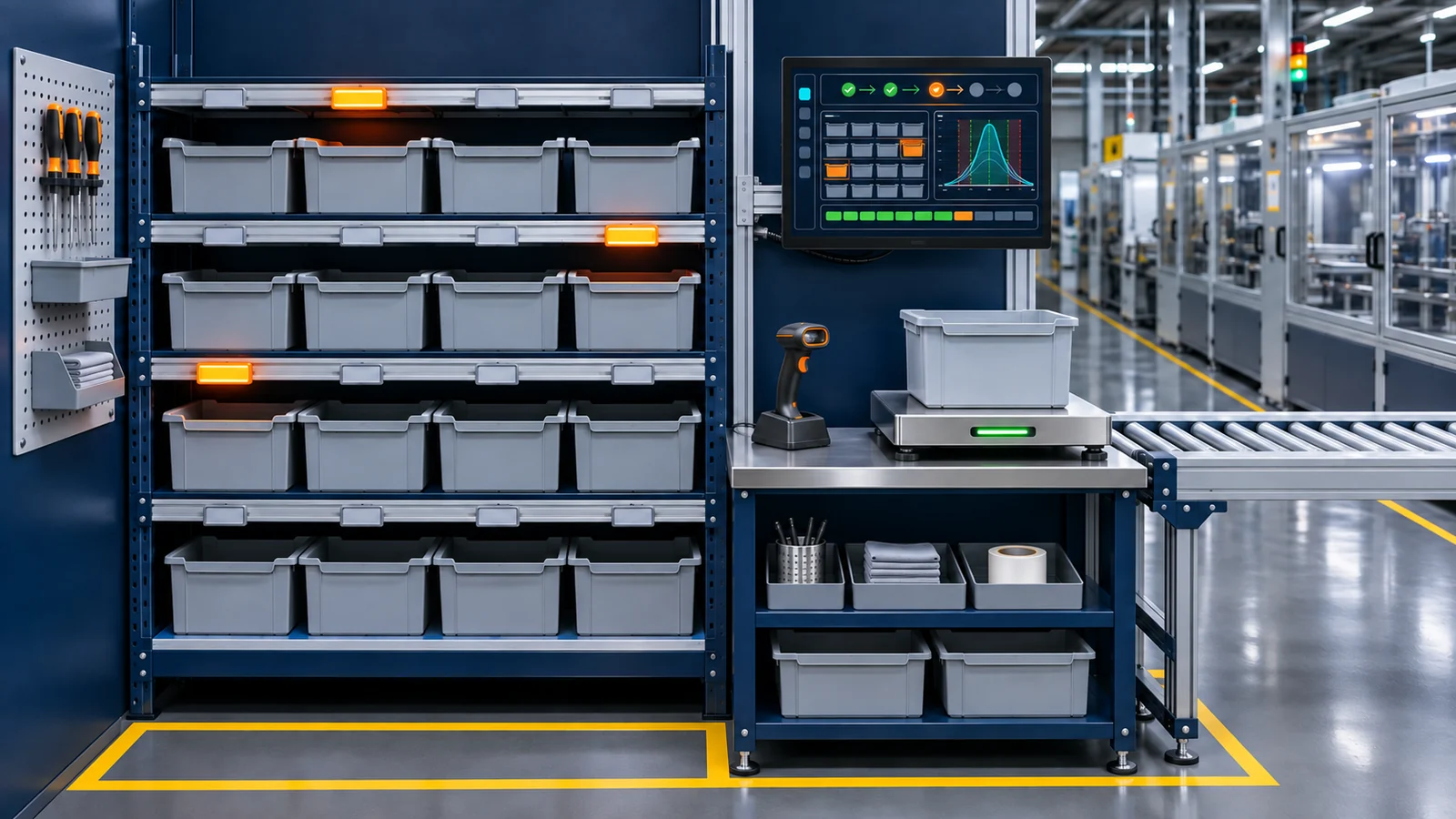
Batching and Feeding Error Proofing with Lot Traceability
Turn recipe requirements into executable checks, weighing steps, and batch records on the shop floor
For manual and semi-automatic batching stations, the system connects recipes, work orders, material barcodes, electronic scales, and feeding confirmation. It records every weighing operation and exception and links raw-material lots to product batches. It reduces the risk of incorrect issues, omitted ingredients, and out-of-tolerance weights without claiming to eliminate human error entirely.
Good fit
Best-Fit Scenarios
- • Food, personal-care, pharmaceutical-support, or other batching operations with requirements for weighing sequence, tolerances, and batch genealogy.
- • Factories with many manual or semi-automatic batching stations that want to retain existing scales while adding online verification.
- • Workshops with work orders and material codes but disconnected records for material issues and returns, weighing, and feeding.
- • Batch processes that need station-specific rules for offline operation, exception overrides, and auditing.
Scenarios Requiring Separate Assessment
- • Projects expecting a guarantee that incorrect or omitted materials and out-of-tolerance events will be eliminated without changing shop-floor practices or exception-management rules.
- • Sites without established material codes, barcodes, and batch definitions that cannot complete basic master-data governance before go-live.
- • Requirements for a complete WMS, laboratory quality management, automated recipe development, or APS scheduling within the same standard product.
- • Hazardous, aseptic, or other special-safety areas without defined constraints for equipment selection, installation, and certification.
Lean manufacturing context
Core capabilities
Controlled Recipe and Work-Order Release
Call the approved recipe version, target weights, weighing sequence, and tolerances for each work order, retaining version and release records. The system of record for recipes and modification rights are defined by project.
Barcode Checks for Material Issues and Returns
Scan material, lot, container, or station barcodes to verify material identity, lot status, and the current task, with warnings or blocks for mismatches, duplicates, or missing steps.
Real-Time Electronic Scale Checks
Capture stable weights and compare them in real time with targets and upper and lower limits, recording taring, weighing, reweighing, and top-ups. Scale interfaces and stability criteria require on-site integration testing.
Out-of-Tolerance Handling and Feeding Confirmation
Apply configured audible and visual alerts, blocks, authorized overrides, or reinspection, recording the operator, reason, and outcome. The target container or equipment can be checked again before feeding.
Batch Genealogy and Weighing Traceability
Link raw-material lots, weighing records, batching lots, feeding equipment, and finished-product batches, supporting both backward tracing from finished products and forward tracing from suspect materials to their destinations.
Offline Buffering and Resumable Operation
Buffer released tasks and shop-floor records under explicit business rules, then resume transmission and verify records by unique identifier after reconnection. Actions permitted offline and those requiring a stop are configured separately.
Access Auditing and Shift Reports
Control rights for recipes, tolerances, overrides, and supplemental entries; summarize task progress, out-of-tolerance events, reweighing, and batch records; and retain audit information for critical changes.
Data and system architecture
Batching-Station Layer
Station terminals, scanners, electronic scales, audible and visual alerts, and necessary feeding interlocks support shop-floor actions while clearly displaying the current task and batch.
Edge Buffering and Device-Interface Layer
Handle scale communications, barcode input, stable-weight detection, and offline buffering to reduce the effects of network fluctuations on operations and record sequencing.
Error-Proofing and Batch Application Layer
Manage recipe versions, tasks, weighing steps, tolerances, exception overrides, and batch genealogy, retaining both raw weights and business-handling records.
Enterprise Integration Layer
Exchange work orders, materials, batches, and results with ERP, MES, WMS, or quality systems, with clear ownership boundaries for inventory accounting and quality disposition.
- Communication interfaces for electronic scales, bench scales, and weighing instruments
- One-dimensional and two-dimensional barcodes, RFID, and label printers
- PLCs, feeding valve manifolds, and container or station interlock signals
- ERP/MES work-order, recipe-version, and production-task interfaces
- Agreed data interfaces for WMS or material issue and return processes
- Database, REST API, or message-queue integration
- Audible and visual alarms, shop-floor dashboards, and enterprise messaging interfaces
Implementation
- 1
Batching-Process and Risk Review
Walk through material issue, staging, weighing, returns, and feeding to identify risks such as similar materials, cross-contamination, wrong stations, and out-of-tolerance weights.
- 2
Recipe and Batch-Rule Design
Confirm recipe ownership, versions, tolerances, barcodes, lot splitting and merging, and exception-override rights to produce testable error-proofing rules.
- 3
Station Prototype and Scale Integration
Validate scanning, taring, stable weights, reweighing, top-ups, and feeding confirmation, and verify shop-floor actions under different network and device failures.
- 4
Pilot Run and Genealogy Acceptance
Use representative recipes for parallel records and verify closed-loop data through forward tracing from materials, backward tracing from finished products, and scoping of abnormal batches.
- 5
Training and Phased Rollout
Train operators, recipe maintainers, and exception handlers; establish inspection and backup routines; and review material and equipment differences before replicating to new stations.
Deliverables
- ✓ Batching-process, risk-point, and error-proofing-rule inventory
- ✓ Design for recipe versions, barcodes, tolerances, and batch genealogy
- ✓ Station error-proofing and weighing-traceability application configured to the agreed scope
- ✓ Documentation for scale, scanning, interlock, and enterprise-system interfaces
- ✓ Handling rules for out-of-tolerance events, reweighing, overrides, and offline operation
- ✓ Acceptance records for forward and backward traceability and exception scenarios
- ✓ Operator training, access-audit, and maintenance documentation
Frequently asked questions
Can the system guarantee that incorrect or omitted ingredients will never occur?
No absolute guarantee is possible. Barcode checks, step constraints, real-time weight comparisons, and exception-override records reduce risk, but actual performance also depends on material identification, shop-floor execution, scale condition, and bypass management. Acceptance scenarios should be reviewed continuously.
Can our existing electronic scales be connected directly?
The model, communication interface, output format, stability flag, and sampling behavior must be verified. Supported scales can be integrated directly; where no suitable interface exists, replacing the indicator or adding an acquisition module can be assessed. Manual readings cannot replicate every automatic error-proofing capability.
Can batching continue during a network outage?
Offline operation can be designed according to business risk, but not every action should be allowed offline. Weighing released tasks, scan validation, and buffering can be configured, while actions involving the latest recipe, lot status, or quality release may need to pause. Deduplication and verification are required after recovery.
How are recipe viewing and modification rights controlled?
Roles can restrict recipe viewing, editing, approval, release, and tolerance adjustments, with versions and critical operations recorded. If ERP or another system owns the recipe, this system receives only controlled versions to prevent concurrent edits in multiple places.
Does go-live automatically mean we comply with GMP or ISO certification?
No. The system can provide traceability for personnel, machines, materials, methods, and environment, together with timestamps and batch records, as required by the project. Certification or compliance still depends on the organization's complete management system, execution evidence, and formal audit, not on software functions alone.
Related products
Factory Energy Management and Energy Analysis
Break down utility bills by area, system, equipment, and product to build an explainable energy baseline
Production-Line MES and Quality Traceability
Ground work-order execution in evidence, record process exceptions, and make product genealogy traceable
OEE and Andon Visualization
Go beyond a single metric by breaking losses into actionable causes and accountability loops
Related insights
Manual Batching Error-proofing Guide: From Scan Prompts to a Closed Weighing Loop
The direct answer for manual batching error-proofing is to combine recipe version, material identity, addition sequence, live weight, tolerance and exception authorization into an execution chain that cannot be skipped at will. Scanning answers ‘Is this the right material?’ Weighing comparison answers ‘Is the quantity within the allowed range?’ Lot linkage answers ‘Can the event be traced afterward?’ All three must be designed together with material issue and return, lot changeover and exception handling. On-screen prompts alone cannot justify a claim that errors have been eliminated.
Forward and Backward Traceability: Connect Product Identity and Process Evidence in One Graph
The direct answer for forward and backward traceability is to support both query directions around the same identity relationships. Backward tracing starts with a finished product or lot and identifies the materials used, equipment and processes involved, operators and quality results. Forward tracking starts with a suspect material, equipment item, tool or process abnormality and identifies potentially affected work in process and finished goods. Both share one event chain; they are not two separately built reports.
The Seven Wastes of Lean Production: From Shop-floor Identification to Data-supported Improvement
The direct answer for the seven wastes is to classify activities that do not create customer value as overproduction, waiting, transportation, overprocessing, inventory, motion and defects, then use shop-floor observation and process data to locate where they occur, how long they last and what triggers them. Classification alone does not improve anything. Waste moves from being seen to being reduced only when it is connected to ownership, standard work, abnormality handling and a regular review cadence.

Prove error proofing and traceability with one representative recipe
Verify materials, weights, containers, and batches step by step from issue to feeding, validating the rules and shop-floor actions before deciding on rollout scope.