
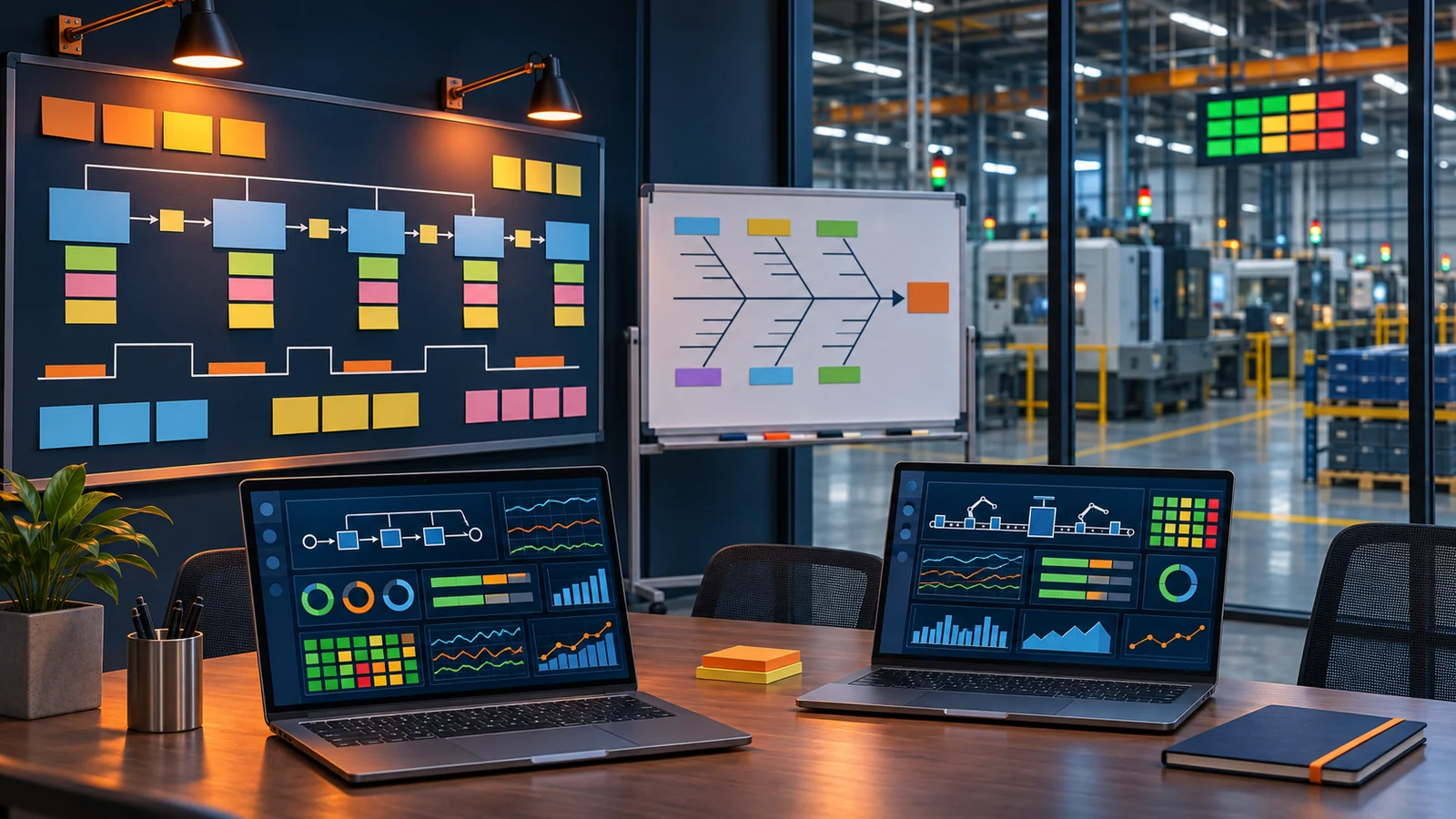
Implementation Method
From validation on one line to a replicable, maintainable shop-floor system
Implementation centers on problems, data, and closed loops: understand the shop floor and interfaces, validate definitions and workflows in a single-line pilot, replicate after acceptance with differences addressed, and maintain data quality continuously.
01 Current-State Assessment: Define the Problem and Boundaries First
Walk the shop floor with relevant production, equipment, quality, process, and IT roles, recording where problems occur, how frequency is defined, current handling processes, and existing records. This stage does not rush to define every function; it identifies the closed loops most worth validating first.
Outputs should include pilot candidates, key roles, current workflows, major constraints, and assumptions requiring verification. For problems without baseline data, design the recording method first to avoid later comparisons using inconsistent definitions.
- Confirm line, operation, product, and shift boundaries
- Distinguish confirmed facts, shop-floor descriptions, and judgments requiring validation
- Agree on baseline metrics, data sources, and reporting methods
02 Data and Interface Inventory: Confirm the Source of Every Figure
Inventory equipment controllers, sensors, instruments, network conditions, and existing systems, documenting available signals, protocols, sampling methods, time synchronization, and responsible parties item by item. For ERP, WMS, QMS, and other systems, also define master-data ownership and business-trigger direction.
Data that cannot be obtained automatically should not be hidden. Added acquisition, edge gateways, or manual supplemental entry can be assessed, but their accuracy, latency, and maintenance costs must be identified and future modification options retained.
- Create inventories of equipment, measurement points, protocols, and networks
- Build data dictionaries for equipment states, work orders, materials, and quality
- Define interface permissions, exception retries, resumable backfill, and test conditions
- Identify differences among automatically acquired, manually entered, and derived data
03 Single-Line Pilot: Prove Real Operation within a Limited Scope
Select a line or process section with a clear problem, an engaged shop-floor team, and verifiable data conditions. The pilot configuration should cover actual shifts and exception scenarios, not only demonstrations of normal production.
Before go-live, prepare account permissions, foundational data, operating rules, and fallback methods. During operation, record acquisition interruptions, state misclassification, missed production reports, and user feedback, resolving them item by item through the issue log.
- Freeze the pilot scope, metric definitions, and acceptance scenarios
- Validate with actual work orders, equipment states, and exception workflows
- Retain the issue log, configuration changes, and handling outcomes
04 Closed-Loop Acceptance: Validate Data, Actions, and Results
Acceptance is not just whether a screen opens. It also examines whether data are trustworthy, exceptions are handled, outcomes can be written back, and reports can be verified against agreed definitions.
Acceptance can be divided into acquisition stability, business completeness, permissions and exception scenarios, metric consistency, and role operation. Items that do not meet conditions should enter corrective action or future scope, with no demonstration data substituted for shop-floor acceptance.
| Acceptance Dimension | Questions to Confirm |
|---|---|
| Data | Are sources traceable, and are timestamps and business objects associated correctly? |
| Workflow | Do exceptions trigger handling, and are ownership and outcomes recorded? |
| Metrics | Can the agreed results be recalculated from the same raw data? |
| Usage | Do the relevant roles understand operation, exceptions, and feedback methods? |
05 Multi-Line Rollout: Reuse Templates While Addressing Differences
Turn the pilot-validated data dictionaries, interface specifications, exception classifications, permissions, and training materials into templates. Before expanding to a new line, recheck equipment models, routings, cycle times, networks, and role differences.
Replication can occur in batches, each with independent verification and fallback arrangements. Where a new line differs substantially from the pilot, return to supplementary assessment rather than forcing the same state conversions or business workflows.
- Distinguish standard templates from line-specific configuration
- Validate acquisition, business scenarios, and metric definitions line by line
- Update training, permissions, documentation, and maintenance checklists together
06 Ongoing Operations: Sustain Data Quality and the Improvement Mechanism
After go-live, interface interruptions, equipment modifications, product changes, master-data changes, and staff turnover still require attention. Maintenance scope should include issue intake, log and acquisition checks, configuration changes, backup-and-restore exercises, and necessary version maintenance.
Periodically review whether exception classifications remain applicable, reports support actual decisions, and manual supplemental entry has become excessive. New requirements should be assessed for their impact on existing definitions and workflows before iteration is scheduled.
- Establish issue prioritization, response boundaries, and accountable contacts
- Monitor critical interfaces and data gaps, retaining handling records
- Review, validate, and document configuration and metric changes
Frequently asked questions
Can the implementation timeline be fixed in advance?
A reliable timeline cannot be given without understanding the site. Equipment protocols, interface readiness, foundational data, pilot scope, and acceptance scenarios all affect scheduling. A phased plan should follow the current-state assessment and inventory.
Which factory personnel need to participate?
Participation usually includes a business owner and relevant production, equipment, quality, process, and IT roles. Specific participants depend on pilot scope; the key is having people who can confirm definitions, execute workflows, and handle exceptions.
Must the line stop for equipment connectivity and the pilot?
It depends on the connection method, site safety requirements, and modification work. Reading an existing interface differs from installing additional hardware. Construction, testing, and fallback arrangements should be planned after a site survey.
Does acceptance look only at whether OEE or defect rates improve?
No. System-delivery acceptance should also examine data, workflows, permissions, exception scenarios, and role operation. Business or improvement metrics can have separately agreed observation definitions, but output, product mix, and process adjustments must also be considered.
What happens if the pilot does not meet the agreed conditions?
Use the issue log to distinguish data, interface, configuration, workflow, and site-condition causes, then decide on corrective action, scope reduction, or a pause. Unvalidated templates should not be copied directly to additional lines.
Start with a bounded current-state and data assessment
Share the target line, main problems, and existing systems to begin discussing an implementation plan based on a verifiable single-line pilot.