
Industries
Home Appliance & Equipment Manufacturing
Bring multi-brand legacy equipment into one production-coordination and continuous-improvement loop
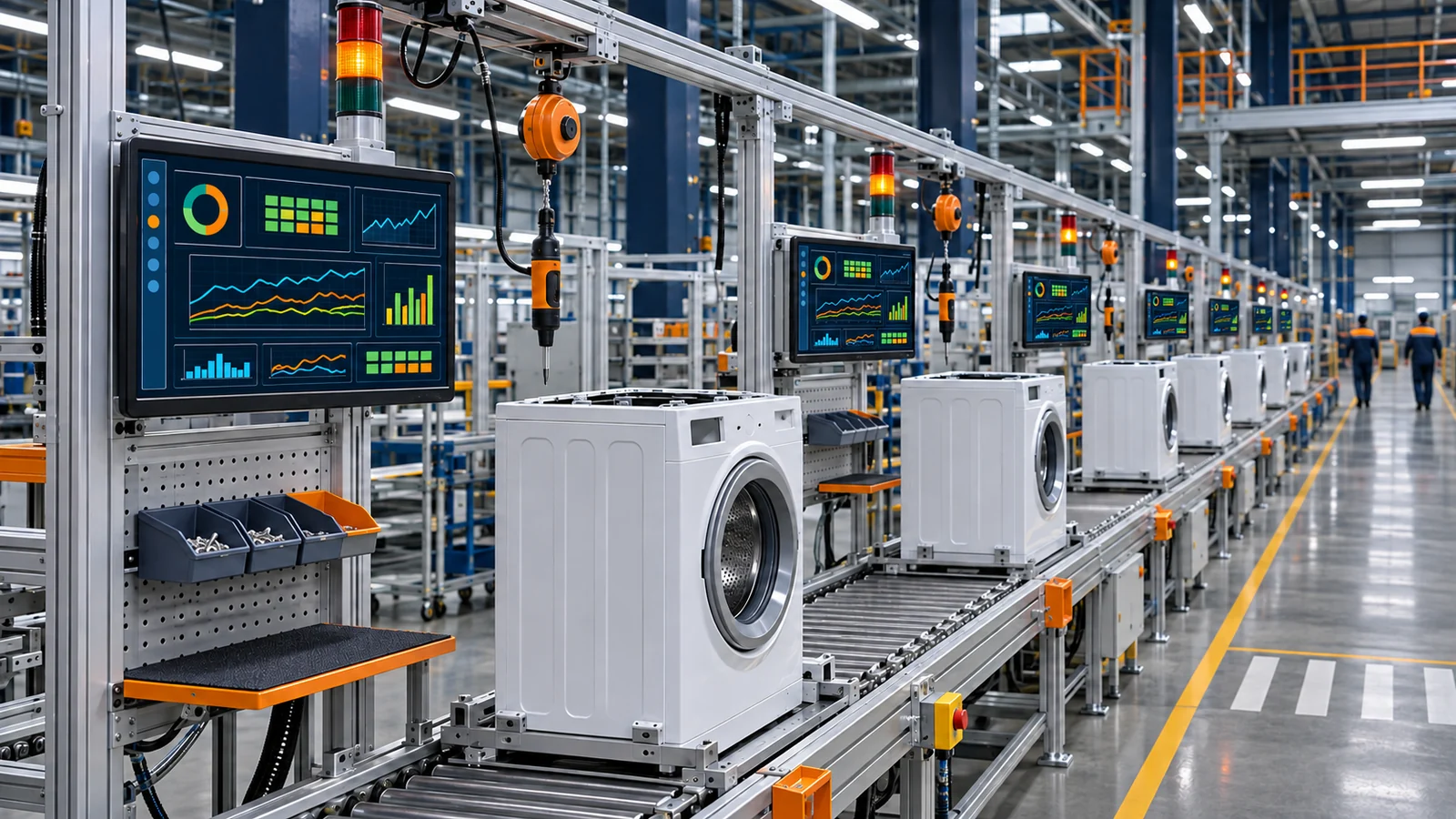
Home appliance and equipment manufacturers often manage numerous product variants, equipment spanning multiple generations, long assembly-and-test chains, and continuous-production constraints at the same time. Shanghai Orpaon starts by verifying equipment interfaces and defining shop-floor data, then combines SCADA, Andon, OEE, MES, and traceability according to line priorities without requiring a one-time replacement of existing systems.
Typical challenges
- PLCs, test equipment, and special-purpose controllers of different ages and brands coexist, with inconsistent data dictionaries and communication conditions.
- Legacy-line upgrades are constrained by production cycle times and shutdown windows, making a single cutover for connectivity, monitoring, and business go-live impractical.
- Incomplete product-identity links across assembly, testing, rework, and packaging force personnel to piece records together manually when locating abnormalities.
- Call, downtime, and minor-stop information is scattered across shift records, making response processes and loss causes difficult to review.
- Planning, process, execution, and test results reside in different systems, leaving line-wide progress and quality status without a shared view.
Solution approach
Multi-Protocol Equipment Connectivity and Data Governance
First inventory equipment, protocols, tags, sampling, and clocks. Then acquire data through OPC, PLC communications, test-equipment interfaces, or custom adapters. Verify interface conditions for legacy or specialized equipment first rather than assuming every device can connect directly.
Production-Line SCADA and Andon Integration
Consolidate equipment states, critical processes, and abnormal-condition calls into unified screens. Configure notifications, response timing, handling records, and escalation rules by event type so every shop-floor issue has a reviewable history from detection to closure.
Line-Wide MES and Execution Coordination
Organize line-wide execution around work orders, product identities, station transactions, process checks, and exception handling. Connect existing enterprise systems according to the project boundary, without treating MES as a replacement for all planning, warehousing, or quality functions.
Assembly, Testing, and Forward/Backward Traceability
Link product barcodes, stations, personnel, tooling, test verdicts, and required process curves under a common key. Support queries from products to processes and reverse identification of affected items by batch, equipment, or abnormal condition.
OEE Loss Transparency
Standardize definitions for runtime, downtime, cycle time, and good count, combining equipment data with shift-team cause confirmation. Distinguish OEE metric calculation, TPM improvement methods, and software presentation to establish a sustainable loss-review mechanism.
Implementation
- 1.
Site Survey and Boundary Confirmation
Verify line processes, equipment interfaces, network conditions, existing systems, and production constraints, and define the acquisition, monitoring, control, and business scope for the current phase.
- 2.
Data Integration in a Pilot Section
Select representative equipment or a representative process section to validate protocols, data quality, product keys, and exception workflows, documenting objects that cannot be connected directly and their alternatives.
- 3.
Phased Upgrades Around Production Windows
Break hardware connectivity, screen configuration, business cutover, and historical-data migration into acceptance-ready steps. Specific shutdown arrangements are subject to site assessment and production approval.
- 4.
Line-Wide Integration and Role-Based Acceptance
Validate the end-to-end chain using work-order flow, abnormal-condition calls, test verdicts, disconnection recovery, and traceability queries, with joint confirmation by production, equipment, quality, and IT.
- 5.
Operational Review and Template Replication
After go-live, continuously validate data definitions, alarm ownership, and improvement actions. Replicate verified interface and screen templates to similar lines while rechecking differences.
Frequently asked questions
Must controllers be replaced to digitalize legacy production lines?
Not necessarily. First inspect available communication ports, protocol documentation, program-modification permissions, and signal quality. Existing interfaces, added communication modules, external acquisition, and manual entry can be combined, but each method requires separate validation of safety, real-time performance, and maintainability.
Can a phased upgrade guarantee zero production downtime?
No such commitment can be made without assessing the site. Offline preparation, pilot-section validation, and staged cutover can reduce production impact. Whether shutdowns are required and their windows depend on the equipment modifications, interlock risks, and the plant's production schedule.
Will a line-wide MES replace ERP, WMS, or QMS?
MES primarily handles shop-floor execution and process coordination; it should not be assumed to replace all enterprise planning, warehousing, or quality-system functions. The project defines system ownership, data keys, and interface directions. Whether separate WMS, QMS, or other systems are needed depends on the existing architecture and requirements assessment.
Can test equipment that produces only result files be included in product traceability?
It can be evaluated, but file naming, product identifiers, timestamps, data integrity, and read stability must first be confirmed. If automatic association is unavailable, scanning triggers, directory monitoring, or interface adapters can establish the relationship, with rules for retransmission and exception handling.
Related products
Machine Data Acquisition and Production-Line Connectivity
Capture data from mixed-vendor equipment accurately and reliably before reusing it for monitoring, traceability, and analysis
Production-Line MES and Quality Traceability
Ground work-order execution in evidence, record process exceptions, and make product genealogy traceable
OEE and Andon Visualization
Go beyond a single metric by breaking losses into actionable causes and accountability loops

Start by Assessing One Representative Legacy Line
Bring the equipment list, process flow, and the abnormal scenarios that most concern shift teams. First confirm the connectable scope and phased implementation boundaries.